, Automatic Electric Gate Openers & Video Intercom Packages & Gate Automation and Intercom Combos & Customised Gate Automation Kit Builders













Buying an automatic gate opener is one of those purchases that looks simple on the surface — until you start reading specs, comparing brands, and realising there are about forty different ways to get it wrong. The wrong motor burns out in two years. The wrong power setup leaves your gate dead every time there's a cloudy week. The wrong kit for your gate type means expensive modifications or a call to a sparky.
This guide cuts through all of that. We've been supplying and supporting gate automation systems to Australian homes and businesses since 2004, and this is the guide we wish had existed when we started.
"The most important decision isn't which brand to buy — it's understanding what your gate actually needs. Get that right first, and the product choice becomes straightforward."
Step 1 — Know Your Gate Type
Before you look at a single product, you need to be clear on what kind of gate you have. Gate openers are not interchangeable between gate types — a sliding gate motor simply won't work on a swing gate, and vice versa.
Sliding Gate
Rolls horizontally along a track or rail system. Ideal for sloped driveways, narrow properties, or anywhere a swinging gate would be impractical.
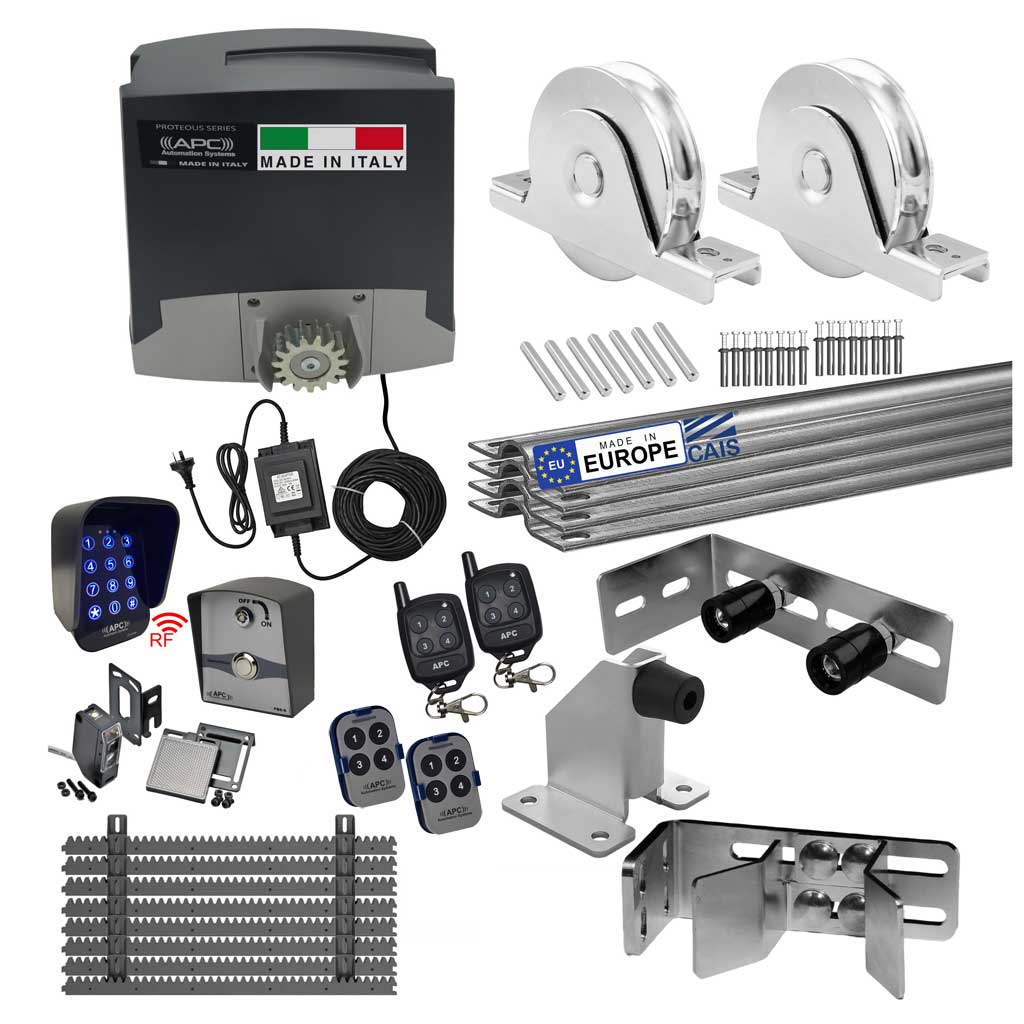
Best for: Space-saving
Single Swing Gate
Hinged on one side, opens inward or outward. The most common residential gate type. Requires clearance space for the arc of the swing.
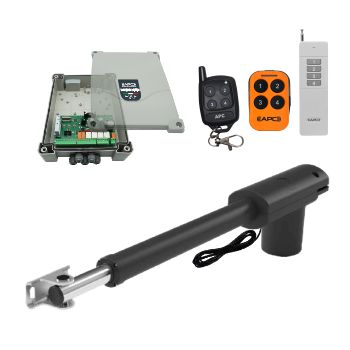
Best for: Most homes
Double Swing Gate
Two panels that open from the centre, like double doors. Common for wider driveways. Requires a synchronized dual-motor setup.
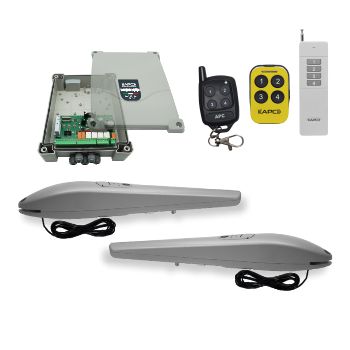
Best for: Wide entries
Farm / Rural Gate
Typically, a single swing gate up to 5 metres wide, often in a remote location without mains power. Solar-powered kits are the go-to solution.
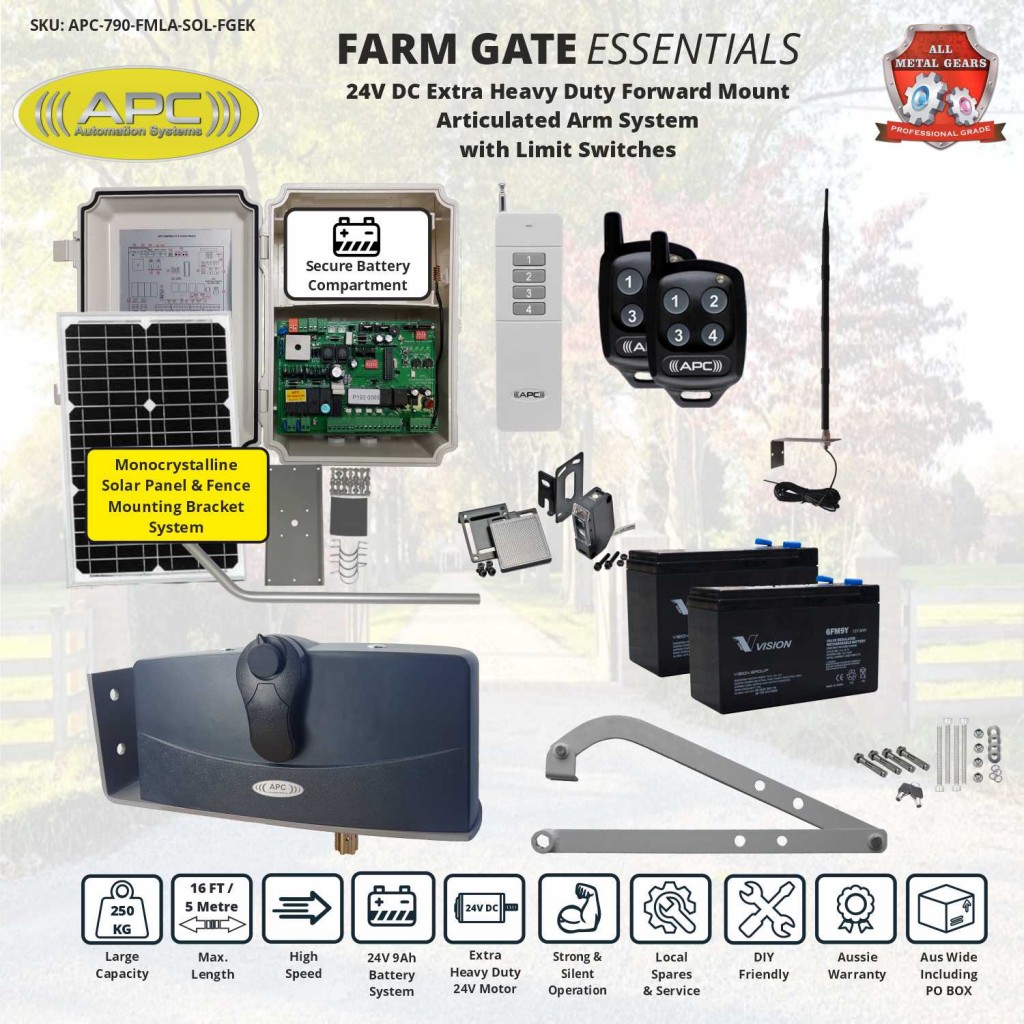
Best for: Rural properties
Quick check: If your gate slides sideways, you need a sliding gate opener. If it swings on hinges, you need a swing gate opener. If it's one panel, single swing. If it's two panels, double swing. Simple.
Step 2 — Choose Your Power Source
Australia's geography means power source is often the most critical decision in the whole purchase. A property in inner Melbourne has different needs from a hobby farm in the Riverina. Here's how to think about it:
Mains-Powered (240V AC)
If you have reliable mains power within reach of your gate (or are happy to have an electrician run a cable), a 240V AC motor is the simplest and most reliable option. You'll never worry about the battery running flat, and these motors are among the most powerful. Note that in Australia, 240V gate opener installations must be wired by a licensed electrician — it's a legal requirement.
Low Voltage (24V DC)
Low-voltage DC systems run off an external transformer or battery pack. They're safer to install (some can be DIY-installed on the low-voltage side without an electrician), quieter, and more energy-efficient. The APC Proteous series and Roger Technology brushless motors are excellent examples. They also typically have built-in battery backup, so a power outage won't trap you inside.
Solar-Powered
For properties without mains power nearby — or for anyone who wants zero running costs — a solar gate opener is the answer. A quality solar system includes a solar panel, one or two 12V batteries, and a gate motor specifically designed for low-power operation. The batteries are charged during the day and run the gate around the clock. For most Australian conditions, a well-sized solar system will run reliably year-round.
Solar Sizing Rule of Thumb
For a standard residential swing gate used 10–20 times per day, a 20W solar panel with a single 12V 12Ah battery is a good starting point. For heavy use (30+ operations/day) or sliding gates, go to 40W+ and dual batteries.
In cloudy southern regions (Tasmania, southern Victoria), size up your panel capacity by 30–50% compared to Queensland or WA.
|
Power Source |
Best For |
Running Cost |
Electrician Required? |
Battery Backup? |
|---|---|---|---|---|
|
240V AC Mains |
Urban/suburban homes near power |
Low (cents/day) |
Yes — legally required |
No Battery Backup |
|
24V DC Low Voltage |
Most residential installations |
Very low |
Depends on transformer setup |
Usually built-in or Optional add-on |
|
Solar |
Rural, remote, or off-grid |
Zero (after install) |
Not required (LV) |
Battery included |
Step 3 — Match Motor Capacity to Your Gate
This is where many buyers go wrong. They buy a motor that's technically rated for their gate size, but not for the frequency of use, and within 12 months the motor is burned out.
Two numbers matter: gate weight and daily cycles.
Every motor has a maximum gate weight capacity and a duty cycle rating. The duty cycle tells you how many opening-and-closing operations the motor can handle continuously before it needs to cool down, and how many per day it's designed for in the long term.
- Light residential (under 10 operations/day): Standard-duty motor at the weight rating of your gate is fine
- Regular residential (10–30 operations/day): Look for "intensive use" rated motors; go one weight class above your gate's actual weight
- High-use or commercial (30+ operations/day): Brushless DC motors (Roger Technology, Motorline) are engineered for this — their permanent magnet brushless technology means no brushes to wear out and dramatically longer service life
- Measure your gate: Weigh it if possible, or estimate conservatively. A steel gate can easily weigh 2–3 times what it looks like it should
Australian conditions matter: Our climate is harsh. Coastal properties need corrosion-resistant motor housings (look for IP54 or better). Outback and inland areas need motors rated for high ambient temperatures. Don't just match the motor to the gate — match it to the environment.
Step 4 — Key Features Worth Paying For
Not all gate opener features are equal. Some are gimmicks; some are genuinely worth the extra investment. Here's our honest take after two decades in the field:
Safety Sensors — Non-Negotiable
Retro-reflective safety sensors (also called photocell sensors or beam sensors) create an invisible beam across the gate opening. If anything breaks that beam while the gate is closing — a car, a child, a dog — the gate stops and reverses. In Australia, this is not optional if children or pets are anywhere near your property. It's also a requirement under the AS 5007 gate safety standard.
Battery Backup
What happens to your gate during a power outage? Without a battery backup, it stops where it is. With one, it keeps operating normally through a standard blackout. For most residential applications, a built-in backup battery providing 50–100 cycles of operation is adequate. If you live in an area prone to extended outages, look for systems with larger backup battery options.
Rolling Code Remotes
Every time you press your remote, a rolling code system generates a brand-new encrypted access code from billions of possibilities. This means "code grabbing" — where someone intercepts your remote signal and replays it to open your gate — is effectively impossible. All quality gate openers from reputable brands now include rolling code technology as standard. Avoid any system that uses fixed codes.
WiFi and App Control
Being able to open your gate from your phone — whether you're in the car or on the other side of the world — has moved from luxury to near-necessity for many households. Look for systems with dedicated WiFi modules or smartphone app integration. Useful scenarios: letting in a tradesperson while you're at work, checking whether you left the gate open, or setting automated open/close schedules for business properties.
Obstacle Detection / Encoder Systems
Higher-end motors include encoder systems that monitor the motor's load during operation. If the gate hits an obstacle — a car parked in the wrong spot, a fallen branch — the motor senses the increased resistance and reverses. This protects your gate, your vehicles, and anyone in the gate's path. It's standard on premium motors like the APC Proteous and Roger Technology brushless range.
Step 5 — Understanding the Main Brands
The Australian market has several well-established brands, and it's worth understanding what each stands for before you buy:
APC Gate Automation
APC is an Australian-designed brand built specifically for local conditions. Their range spans from budget-friendly entry-level kits through to heavy-duty commercial sliding gate motors. The Proteous series (24V DC, Italian-made) is one of the most popular residential sliding gate motors in Australia for good reason — reliable, feature-rich, and well-supported. APC swing gate systems are solid performers across the full range of residential gate sizes.
Roger Technology
Roger Technology is an Italian engineering company specialising in brushless gate automation motors. Their brushless DC motors are genuinely in a different performance class to conventional brush motors — near-silent operation, ultra-high-speed opening, and a service life measured in millions of cycles rather than hundreds of thousands. If you have a high-use application, a heavy gate, or you simply want the best, Roger Technology is the answer.
Motorline
Another European brushless motor specialist. Motorline's 36V brushless range offers excellent speed and torque for large or heavy sliding gates, and their magnetic limit switch technology eliminates the mechanical wear points of traditional spring-limit systems.
DEA Systems
Italian-made, DEA offers a solid mid-to-premium range with good Australian distribution. Popular in both residential and light commercial applications.
Step 6 — Kit Types Explained
Gate opener products are sold in a range of kit configurations. Understanding these helps you avoid either overspending on features you don't need or under-buying and having to purchase extras separately.
| Kit Type | What's Included | Best For |
|---|---|---|
| Trade Kit | Motor, 2 remotes, control board/box, battery backup, gear rack, mounting hardware | Gates that already open manually; tradespeople supplying their own access control |
| Jumbo Kit | Trade kit + 3rd remote, safety sensor, entry & exit buttons | Standard residential installation with basic access control |
| Wireless Controller Kit | Jumbo kit + wireless keypad + wireless exit button | Properties where running wires for entry/exit controls isn't practical |
| WiFi Access Kit | Trade kit + WiFi switch + app control | Smartphone-first households; remote property management |
| Super Kit | All of the above + electric lock + security keypad | Maximum security residential; properties that need a locked-gate solution |
Step 7 — DIY or Professional Installation?
One of the most common questions we get is: " Can I install this myself?
The honest answer is: it depends on the power source.
For 24V DC low-voltage and solar systems, the gate motor and control electronics themselves are low-voltage and can generally be installed by a competent DIYer with basic tools and the ability to follow detailed instructions. The mechanical installation — mounting the motor, setting limits, adjusting travel — takes patience but is very achievable without an electrician.
For 240V AC mains-powered systems, the connection to the mains must be made by a licensed electrician. Full stop. This is an Australian legal requirement, not optional. The motor mounting can still be DIY, but the power connection cannot.
DIY Checklist Before You Start
- Gate moves freely by hand with no binding, sagging, or sticking
- Gate posts and hinges/rail system are solid and level
- You have the correct kit for your gate type, weight, and usage frequency
- Power source sorted (and electrician booked if required)
- You've read the full installation manual before picking up a drill
Step 8 — What Should You Expect to Pay?
Gate opener pricing in Australia varies enormously based on gate type, kit level, and brand. Here's a realistic guide to help you budget:
- Entry-level solar or 24V swing gate kit: $400–$700 — suitable for a standard residential swing gate with moderate use
- Mid-range sliding gate kit (APC): $700–$1,200 — solid reliability for everyday residential sliding gates up to 800kg
- Premium brushless motor kit (Roger Technology / Motorline): $1,200–$2,500 — best-in-class speed, reliability, and longevity; right choice for heavy, large, or frequently used gates
- Professional installation: $400–$1,500 on top of the kit, depending on complexity, access, and whether an electrician is needed
- Commercial/industrial systems: $2,000–$6,000+ — for high-frequency-use or high-weight applications
A note on cheap imports: Sub-$300 gate motor kits from unknown brands exist on marketplaces like eBay. Some are fine for very light, infrequent use. Most will not survive Australian conditions or any meaningful frequency of use. A $400 quality kit that lasts 10+ years is far better value than a $200 kit you replace every two years.
Not sure which kit is right for you?
Our technical team has been helping Australians choose the right gate opener since 2004. Call us free on 1800 694 283 or browse our full range online.
Frequently Asked Questions - FAQs
Do I need an electrician to install a gate opener?
It depends on the power source. Solar and 24V DC low-voltage systems can generally be DIY-installed for the gate motor and electronics without an electrician. However, any 240V AC mains connection must be made by a licensed electrician under Australian law. The mechanical installation of any gate opener can be completed by a competent DIYer with basic tools.
What is the difference between a sliding gate opener and a swing gate opener?
Sliding gate openers drive a gate horizontally along a track or rail — the gate moves sideways. Swing gate openers use linear actuator arms or underground mechanisms to push or pull a gate open on its hinges. The two systems are not interchangeable. You need to know which type of gate you have before buying a motor.
How many operations per day can a gate opener handle?
This varies by model and is called the "duty cycle." Entry-level motors may be rated for 20–30 operations per day. Heavy-duty and brushless motors are often rated for 100+ hours of continuous use. Always match the duty cycle to your actual usage, with some headroom to spare.
Will a solar gate opener work reliably in southern Australia?
Yes, with correct sizing. In areas with fewer peak sun hours (Tasmania, southern Victoria, southern SA), you'll need a larger solar panel (40W+) and more battery capacity than in Queensland or the NT. A well-designed system will operate reliably year-round, including cloudy periods, thanks to battery storage.
What happens to my gate during a power outage?
Most quality gate openers include a battery backup that allows the gate to continue operating for 50–100 cycles during a power outage. All gate openers also include a manual override key that allows you to disengage the motor and operate the gate by hand, regardless of the power situation.
What is rolling code remote technology?
Rolling code (also called hopping code) remote systems generate a new, unique encrypted access code every time you press the button. This prevents "code grabbing" — where a bad actor intercepts your remote signal and replays it to open your gate. All reputable gate opener brands use rolling code technology as standard.
How long should a gate opener last?
A quality gate opener used within its rated duty cycle should last 10–15 years in normal residential use. Brushless DC motors (Roger Technology, Motorline) are designed for even longer service lives. Longevity is strongly influenced by correct installation, keeping the gate itself in good mechanical condition, and not exceeding the motor's rated capacity.