No-Touch Approach Sensor (Proximity Switch) for Automatic Door (Australia) | The Motorline SINTACT High-performance microwave proximity sensor for automatic pedestrian swing doors. It offers reliable no-touch activation, 24 GHz detection, adjustable range, and IP54 weather resistance—perfect for Australian commercial and public installations.
MOL-SINTACT-PBNTProduct Information
No-Touch (Proximity)Approach Sensor for Automatic Pedestrian Swing Doors in Australia
The Motorline SINTACT is a 24.125 GHz microwave no-touch proximity sensor designed for touchless opening of automatic pedestrian swing doors. Simply approach within 35 cm, and the sensor activates the door opener — no handle or button contact required. Compatible with any automatic door operator running on 12–24 V AC/DC, the SINTACT delivers a clean relay output (1 A / 24 V DC) in 1.2 seconds. IP54-rated, surface-mount, and adjustable, it is the ideal no-touch door activation solution for hospitals, aged-care facilities, supermarkets, offices, and commercial buildings across Australia.
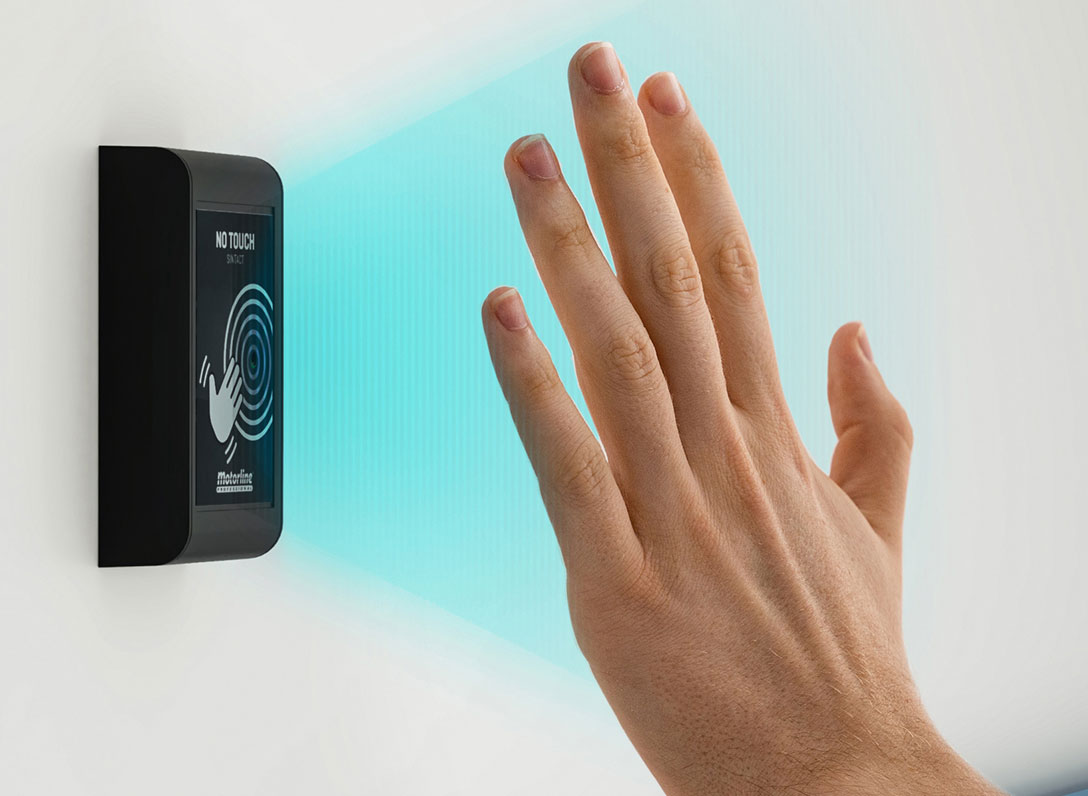
Touchless Door Opening via Microwave Proximity Detection
In today's high-traffic commercial and public environments across Australia, the ability to open a door without touching a handle, push plate, or intercom button is no longer a luxury — it is a hygiene and accessibility expectation. The Motorline SINTACT is a purpose-built, no-touch proximity sensor that uses microwave detection technology to trigger automatic swing door openers the moment a person approaches, delivering seamless, touchless pedestrian access with zero physical contact.
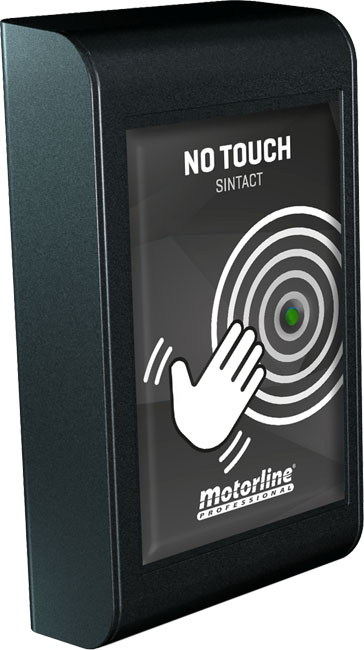
How Microwave Proximity Detection Works
Unlike traditional passive infrared (PIR) sensors that rely on body heat and can fail in bright sunlight or backlit environments, the SINTACT uses active microwave detection operating at 24.125 GHz. The sensor continuously transmits a low-power microwave signal and monitors for the Doppler shift caused by a hand or body approaching its face. When movement is detected within the 20–40 cm detection zone, the sensor's relay output closes, sending a trigger signal directly to the automatic door operator's control board.
This microwave-based approach makes the SINTACT reliable in all ambient lighting conditions — from sun-drenched shopping centre foyers to dimly lit hospital corridors and back-of-house service entries — making it the superior choice for opening automated doors by proximity across Australian climates.
Designed for Any Automatic Door Opener in Australia
The SINTACT is engineered to be universal. With a power supply range of 12–24 V AC/DC and a dry-contact relay output (Normally Open / Common at 1 A / 24 V DC), it integrates directly with virtually every major automatic door operator control board available in Australia — including Motorline's own pedestrian swing door systems and third-party brands. The 2,500 mm pre-wired cable is long enough to reach most control boards without extension in standard door frame installations.
Two wiring outputs — one for the relay contact (NO and COM) and one for power (12–24 V AC/DC) — make the connection straightforward, and the on-board potentiometer allows fine-tuning of sensitivity without special tools.
The Right Choice for Hygiene, Accessibility, and Convenience in Australia
The SINTACT was developed in direct response to the growing need for no-touch door solutions in healthcare, aged care, retail, hospitality, and office environments. Whether used as a no-touch proximity sensor for automatic door exit on the interior of a swing door — allowing occupants to leave without touching anything — or as an entry approach sensor triggering door opening from the exterior, the SINTACT provides a proven, low-maintenance solution that works every time.
The SINTACT is manufactured by Motorline, a Portuguese automation brand with ISO 9001 and ISO 14001 certification, and is the recommended accessory sensor for Motorline's full range of pedestrian automatic swing door operators.
Key Features of the SINTACT No-Touch Sensor
- No-touch door activation — 35 cm microwave detection range means users simply approach the door; no handle, button, or surface contact needed.
- 24.125 GHz microwave technology — works reliably in any lighting condition, including bright direct sunlight or dark back-lit entry points where passive infrared (PIR) sensors fail.
- Adjustable detection sensitivity — built-in potentiometer lets installers fine-tune the sensor response to hand movement speed (min. ±5 cm/s, max. ±1 m/s), minimising false triggers.
- Wide power supply compatibility — operates on 12–24 V AC/DC (±30%/−10%), universally compatible with existing Australian automatic door opener control boards.
- IP54 ingress protection — dust-resistant and splash-proof for reliable operation in hospitals, supermarkets, aged-care facilities, and commercial building entries.
- Relay output (1 A / 24 V DC) with 1.2-second actuation — clean dry-contact output integrates directly with standard swing door operator control boards without additional relay modules.
- Rotating bracket adjusts 180° — allows precise aiming of the detection field without tool modifications, simplifying installation on frames, walls, or door headers.
- Surface-mount installation — no embedded wiring or wall chasing required; adheres and fixes to wood, plaster, plastic, or glass.
- Wide operating temperature range — rated from −25 °C to +55 °C, suitable for Australia's climate zones from tropical Queensland to alpine Victoria.
- Compact ABS housing — 66 × 110 × 30 mm, 265 g; low-profile design blends into commercial door frames with minimal visual intrusion.
- Compatible with any automatic door type — swing gates, pedestrian swing doors, sliding doors, and any automated access system with a dry-contact trigger input.
- 2,500 mm pre-wired cable — ready to connect to the door controller with no additional field wiring on most installations.
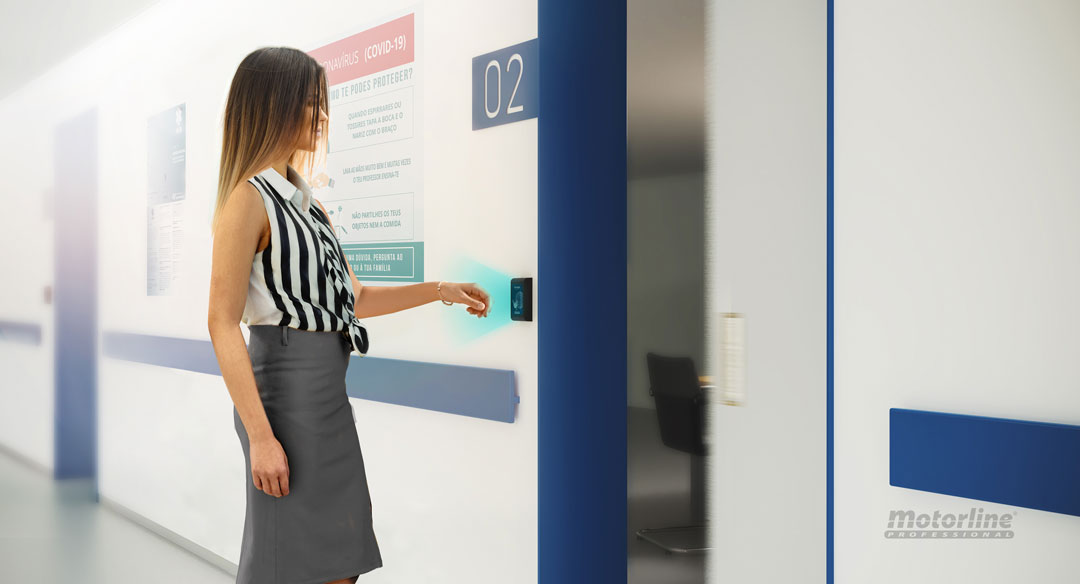
Why Choose a No-Touch Proximity Sensor for Your Automatic Door Opener?
Hygiene & Infection Control
Eliminating surface contact at high-traffic entry points is one of the most effective environmental infection-control measures available. By triggering the automatic door opener via proximity rather than touch, the SINTACT removes a critical fomite transmission point. Recommended for hospitals, medical centres, dental surgeries, aged care homes, childcare centres, food processing plants, commercial kitchens, and any public building governed by ACSQHC, NDIS, or Food Standards Australia New Zealand (FSANZ) protocols.
Accessibility & DDA Compliance
Hands-free door operation directly supports accessible design principles under AS 1428 (Design for Access and Mobility) and the intent of the Disability Discrimination Act 1992 (DDA). For buildings required to meet DDA compliance, a proximity-activated automatic swing door removes a significant barrier for wheelchair users, people with upper limb impairments, the elderly, parents with prams, and delivery personnel.
Operational Efficiency
At high-traffic entry and exit points — supermarket receiving docks, hospital corridors, office lobbies, hotel back-of-house — hands-free automatic door activation reduces pedestrian queuing and friction. Staff carrying trays, equipment, or stock can pass through without pausing to operate a door control.
Reduced Vandalism & Wear
Push-plate activators and intercom buttons in commercial environments are frequent targets for vandalism and wear rapidly in high-use settings. The SINTACT has no surface-mounted mechanical components — the detection field is the only interface — dramatically reducing maintenance callouts and replacement cycles.
Versatile Installation — Entry and Exit
The SINTACT can be deployed on either side of a door: as an exterior approach sensor to open the door when someone arrives, or as an interior exit sensor to allow egress without touching. This dual-function capability means a single product specification covers both entry and exit no-touch activation requirements on any automatic swing door installation.
Climate Resilience Across Australia
With an operating temperature range of −25 °C to +55 °C and IP54 protection, the SINTACT performs across Australia's diverse climate zones — tropical Northern Territory and Queensland, temperate coastal New South Wales and Victoria, and the arid interior. It is not affected by direct sunlight or high ambient temperatures, which can impair PIR-based sensors.
Technical Specifications — SINTACT Microwave Proximity[Approach] Sensor
All data sourced from the official Motorline SINTACT Operation Manual (v1.0 Rev. 08/2020).
| Parameter | Specification |
|---|---|
| Sensor Technology | Microwave Motion Detection (Doppler) |
| Transmission Frequency | 24.125 GHz |
| Detection Type | Movement |
| Detection Distance | 20 cm to 40 cm (approximately 35 cm nominal) |
| Minimum Movement Speed | ±5 cm/s |
| Maximum Movement Speed | ±1 m/s |
| Power Supply | 12 V – 24 V AC/DC (+30% / −10%) |
| Supply Frequency | 50 – 60 Hz |
| Power Consumption | <2 W (VA) |
| Relay Output | Normally Open (NO) + Common (COM) |
| Maximum Relay Contact Voltage | 1 A / 24 V DC |
| Relay Actuation Time | 1.2 seconds |
| Operating Temperature | −25 °C to +55 °C |
| Ingress Protection Rating | IP54 (dust-protected, splash-resistant) |
| Compliance Standards | R&TTE 1999/5/EC; EMC 89/336/EEC |
| Housing Material | ABS (Acrylonitrile Butadiene Styrene) |
| Housing Colour | Black |
| Dimensions (L × H × D) | 66 × 110 × 30 mm |
| Weight | 265 g |
| Cable Length | 2,500 mm (pre-wired, 4-wire) |
| Wire Colours / Functions | White = Automation output | Green = NO relay | Yellow = COM relay | Brown = 12–24 V AC/DC |
| Mounting | Surface mount via rotating wall bracket (180° adjustment), adhesive or screw fix |
| Compatible Surfaces | Wood, plaster, plastic, glass |
| Sensitivity Adjustment | Via internal potentiometer (hand movement speed) |
| Manual Reference | Operation Manual v1.0 Rev. 08/2020 (EN/DE/RU) |
Compatible Motorline Door Operators
| Model | Description |
|---|---|
| M1805-ECO | Motorline M1805-ECO swing door operator |
| ME1805 | Motorline ME1805 emergency / main entrance swing door operator |
| Universal | Any automatic door operator with a 12–24 V DC/AC relay trigger input |
Easy Installation — No Embedded Wiring Required
Standard installation procedure from the SINTACT Operation Manual v1.0 Rev. 08/2020. Typical installation time under 30 minutes for an experienced door automation technician or licensed electrician.
- Loosen the 4 screws and remove the device cover to access internal components.
- Loosen the 2 screws on the PCB, remove it, and then place the provided seal.
- Insert the cable through the housing and connect the plug to the PCB.
- Retighten the PCB screws and connect the SINTACT to the door controller per the wiring diagram: White → Automation | Green → NO relay | Yellow → COM relay | Brown → 12–24 V AC/DC.
- Test sensor sensitivity — adjust the internal potentiometer as needed until the sensor reliably detects hand movement at the desired range without responding to background movement.
- Close the housing, tighten all screws, then remove the adhesive film and fix the sensor to the mounting surface (wall, frame, glass, or plaster).
- Set the rotating bracket to aim the detection cone at the expected pedestrian approach path. Do not mount within the door's swing arc.
Installation Warnings
- Do not install within the door's opening angle — the swinging door will trigger false activations.
- Avoid placing fluorescent lamps close to the sensor — they may interfere with microwave detection.
- Do not cover or block the sensor's detection area with objects or signage.
- Do not touch the electronic components inside the housing — risk of ESD damage.
- Do not move objects in front of the device during normal operation — this will trigger the door.
Where to Use the SINTACT No-Touch Approach Sensor: Applications Across Australia
The SINTACT no-touch proximity sensor is suited to any commercial, public, or industrial building in Australia that uses an automatic pedestrian swing door and requires touchless activation. Typical applications include:
- Hospitals and medical centres — infection control at ward entries, operating theatre corridors, and patient room access points.
- Aged care and disability facilities — hands-free access for residents with limited mobility, supporting DDA and AS 1428 compliance.
- Supermarkets and retail — high-throughput entry and exit without handle contact; staff pass-through for stock handling.
- Commercial office buildings — lobby and internal door automation with no-touch convenience for staff and visitors.
- Hospitality and hotels — back-of-house corridors, kitchen entries, and service access points.
- Food processing and commercial kitchens — hands-free operation to maintain hygiene standards in FSANZ-regulated environments.
- Childcare centres and schools — hygienic entry points reducing surface-contact transmission risk.
- Car parks and covered entry points — IP54-rated for semi-outdoor covered access lanes and pedestrian gates.
- Pharmaceutical and cleanroom facilities — touchless door activation in contamination-controlled zones.
Frequently Asked Questions: No-Touch Approach Door Sensors in Australia
What is a no-touch proximity sensor for an automatic door opener?
A no-touch proximity sensor — such as the Motorline SINTACT — detects the approach of a hand or body and sends a trigger signal to an automatic door opener, causing the door to open without physical contact. The SINTACT uses 24.125 GHz microwave technology to detect movement within a 35 cm detection zone. When triggered, it closes a relay output connected to the automatic door operator's control board, initiating the door open cycle. Unlike a push plate or intercom button, no surface needs to be touched — making it ideal for hygiene-critical and accessibility-focused applications across Australia.
How does a microwave detection sensor open an automatic pedestrian swing door?
The SINTACT continuously transmits a low-power 24 GHz microwave signal in front of its face. When a hand or body moves into the detection zone (20–40 cm from the sensor), the returning signal shows a Doppler frequency shift. The sensor's onboard electronics detect this shift, close the relay contact (NO to COM), and hold it for 1.2 seconds — long enough for the automatic door operator's control board to register the trigger and open the door.
What is the detection range of the Motorline SINTACT proximity sensor?
The SINTACT has an adjustable detection range of 20 to 40 cm, with a nominal operating range of approximately 35 cm. The internal potentiometer allows the installer to fine-tune detection sensitivity to match specific installation requirements — for example, reducing the range in a narrow corridor to prevent accidental triggers from pedestrians passing without intending to use the door.
What is the difference between a microwave proximity sensor and a PIR sensor for automatic doors?
A passive infrared (PIR) sensor detects changes in infrared (heat) radiation from a moving body. PIR sensors can be unreliable in high-ambient-temperature environments, direct sunlight, or areas with background heat sources — all common challenges in Australian climates and sun-exposed entry points. A microwave sensor like the SINTACT actively transmits and receives a 24 GHz signal, detecting movement via Doppler shift regardless of ambient light or temperature. This makes microwave sensors consistently more reliable in outdoor-adjacent, bright, or thermally challenging locations.
Is the SINTACT no-touch sensor compatible with all automatic swing door openers in Australia?
Yes. The SINTACT is designed to be universally compatible with automatic door operators that accept a dry-contact relay trigger input. It operates on 12–24 V AC/DC — the standard power supply range for the vast majority of automatic door control boards available in Australia. It is the manufacturer-recommended proximity sensor for Motorline's full range of pedestrian swing door operators and integrates seamlessly with compatible third-party swing and sliding door operators.
Where should a no-touch proximity sensor be installed on an automatic door?
The SINTACT should be mounted on the wall or door frame beside or above the door, with the sensor face aimed toward the expected approach direction of users. For an entry sensor, mount on the exterior frame at approximately 800–1,000 mm from the finished floor — suitable for both standing adults and wheelchair users. For an exit sensor, mount on the interior frame at the same height. The 180° rotating bracket allows fine adjustment of the detection cone. Do not mount within the door's swing arc, and avoid positions near fluorescent lights.
Can the SINTACT no-touch approach sensor be used as an automatic door exit sensor?
Yes. The SINTACT is equally effective as a no-touch proximity sensor for automatic door exit, allowing occupants to leave through an automatic swing door without touching any surface. Mount the sensor on the interior side of the door frame, aimed toward the egress approach path. This is particularly valuable in healthcare, food processing, and aged care environments where hand-hygiene protocols require that door handles and push plates be avoided at all times — including on exit.
Does installing the SINTACT no-touch sensor require embedded wiring or wall chasing?
No. The SINTACT automatic door enter/exit sensor is designed for surface-mount installation. It includes a wall bracket that screws into or adheres to wood, plaster, plastic, or glass surfaces, with no wall chasing or embedded conduit required. The 2,500 mm pre-wired cable is routed surface-mount or through a conduit to the door controller. Installation typically takes under 30 minutes for an experienced door automation technician or licensed electrician.
What power supply voltage does the Motorline SINTACT sensor require?
The SINTACT automatic door sensor operates on 12-24 V AC or DC, with a tolerance of ±30 %. Power is typically drawn directly from the automatic door operator's auxiliary power output, eliminating the need for a separate power supply in most installations. Current draw is less than 2 W, placing a negligible load on the door operator's power supply.
Is the Motorline SINTACT proximity sensor suitable for outdoor or semi-outdoor use in Australia?
The SINTACT no-touch sensor carries an IP54 ingress protection rating, making it dust-protected and resistant to water splashing from any direction. This makes it suitable for covered outdoor entry points such as building porticos, covered car park pedestrian gates, and undercover commercial loading docks. It is not rated for full immersion or sustained exposure to driving rain — for fully exposed outdoor installations, additional weatherproof housing is recommended. Its operating temperature range (−25 °C to +55 °C) covers Australia's full climate spectrum.
Can the SINTACT proximity sensor trigger false door openings?
The SINTACT no-touch proximity sensors potentiometer allows installers to calibrate sensitivity, minimising false triggers from slow ambient movement such as curtains, plant foliage, or HVAC airflow. The sensor detects directional hand movement rather than static presence. Correct positioning — away from the door's swing arc, away from fluorescent lights, and not facing moving objects — eliminates the vast majority of false activation events.
What Australian standards are relevant to no-touch proximity sensors for automatic doors?
While the SINTACT no-touch proximity sensor is CE-marked to European standards (R&TTE 1999/5/EC and EMC 89/336/EEC), its application in Australian automatic door systems is governed by several relevant standards. These include AS 5007 (Power-operated pedestrian door systems — safety in use), AS 1428 (Design for Access and Mobility), the Disability Discrimination Act 1992 (DDA), and NCC/BCA accessibility provisions. Always consult a licensed door automation installer familiar with Australian compliance requirements.